
Who Is Your Character Beyond the Script? — AI Lumière Journal
AI Lumière
←Journal
Essay20.11.2026Margaret Tkachuk

Who Is Your Character Beyond the Script?

Every screenplay tells a story, and behind every story are characters with dreams, fears, secrets and emotions. A filmmaker reads a script to understand why things happen and what they mean for the whole story, not just what happens in each scene. This is the narrative approach we are building into AI Lumière. To show it, we wrote a short script, “First Film”, and took its heroine Emma through the platform.

01Look Beyond the Individual Scene

The director uploads the complete screenplay. The platform divides it into scenes and writes the logline, the core conflict and the synopsis. It also detects the genre: for “First Film” it proposed psychological drama. The director confirms the genre or changes it, because it will shape the visual style of every character, location and frame.
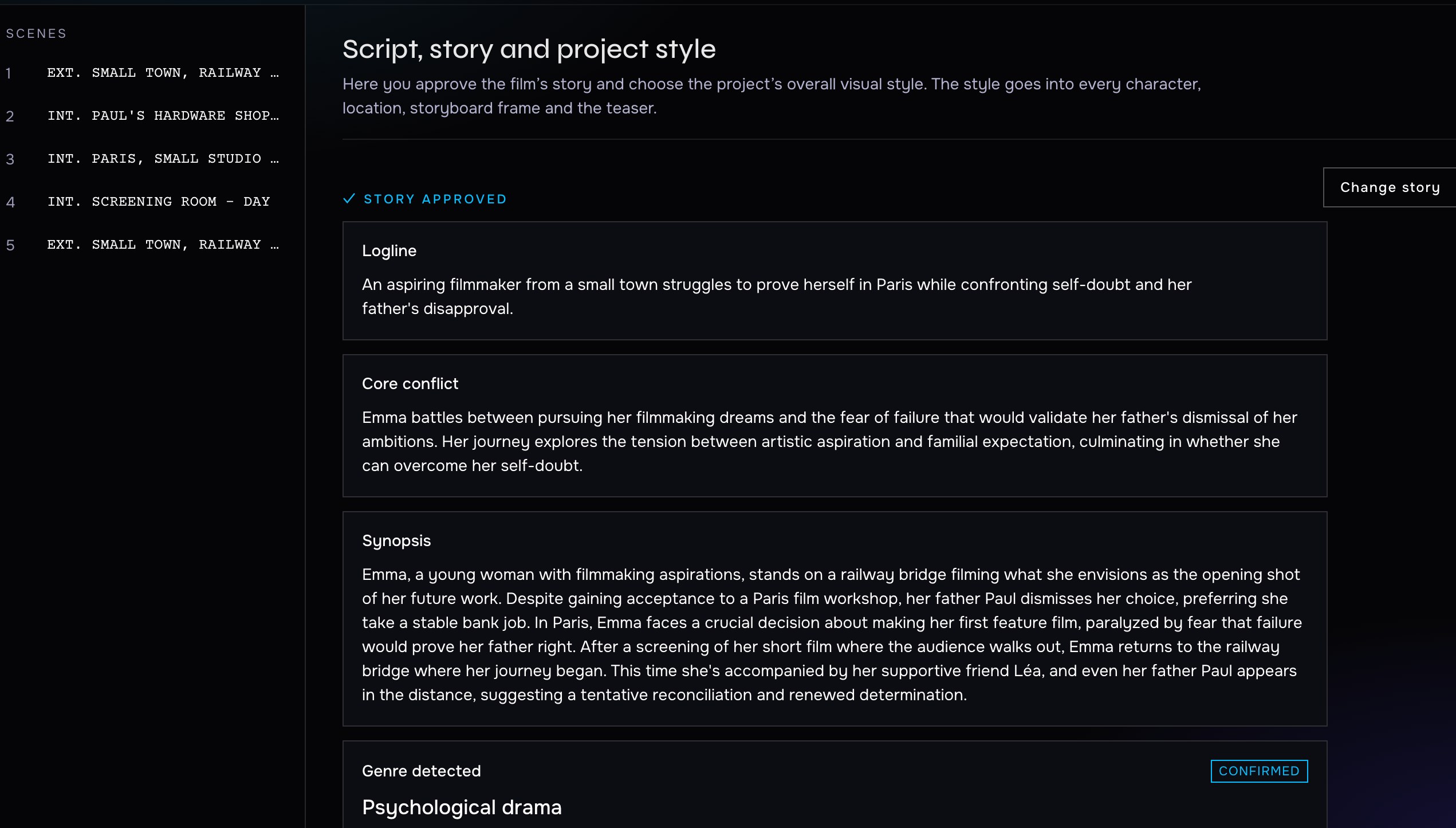
The Script stage: five scenes, logline, core conflict, synopsis and the detected genre.
The Script stage: five scenes, logline, core conflict and synopsis. The genre is detected by the platform and confirmed by the director.

From there, we explore the script as a whole and ask the questions a director asks:

  • What is the story about?
  • Who are the main and secondary characters?
  • What are their personalities, motivations, dreams, fears and conflicts?
  • How are the characters connected?
  • When and where do they appear?
  • How do they change throughout the story?
  • How can that development be translated into storyboard frames?

02The Character Bible

A character bible describes the important details of each character in a film or series. It gives the director, the screenwriter and the storyboard artist a shared and clearer picture of the people in the story.

In the platform, the bible has two parts. Identity: name, age, period, the scenes where the character appears. Character: who this person is, their role in the story, motivation and relationships. Everything is taken from the script, and what the script does not say is marked as such. Emma’s age, for example, is “Not specified in script”.
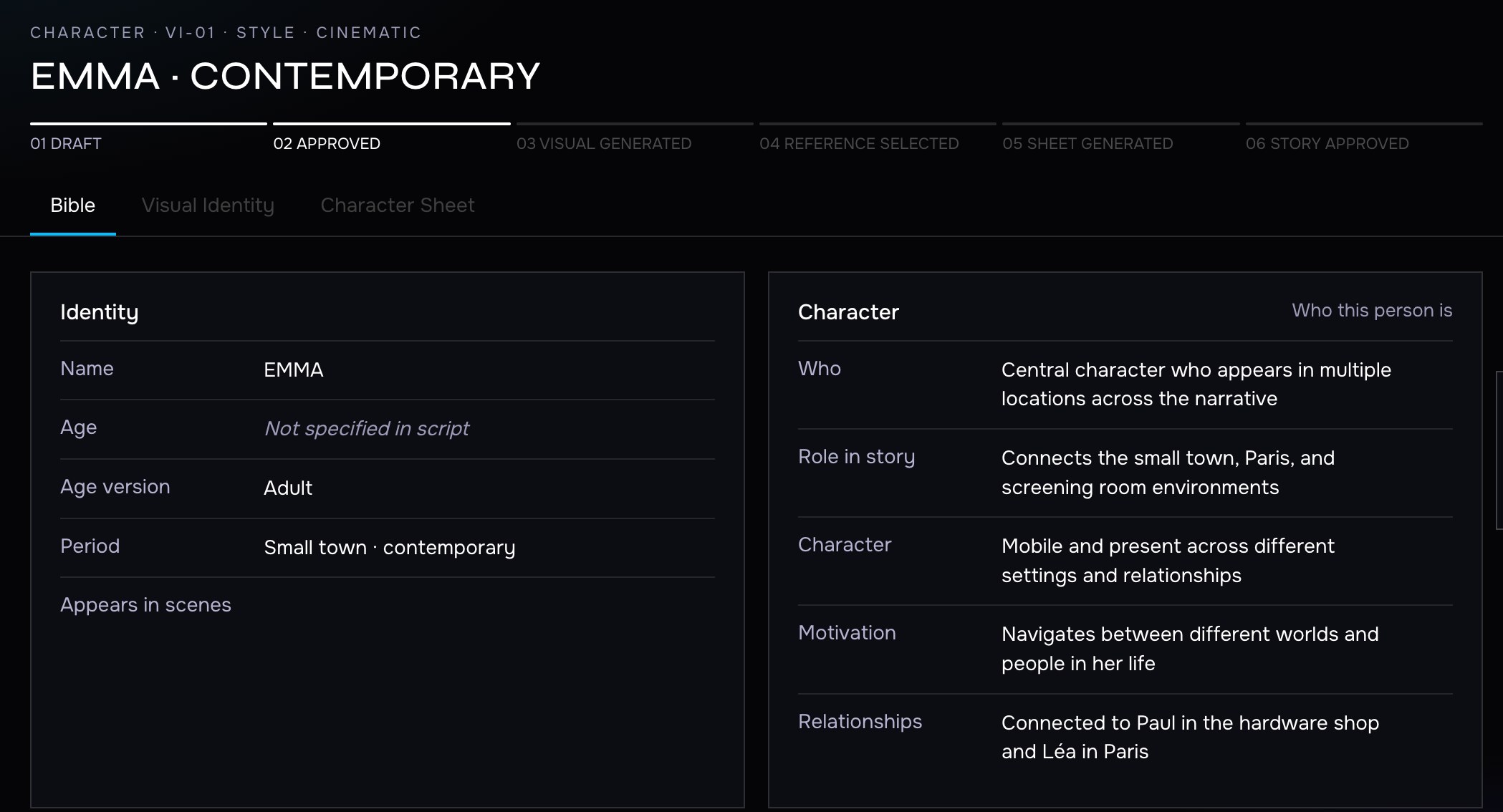
Emma’s character bible: Identity and Character.
Emma’s bible as drafted from the script. The director approves it or adds what is missing.

The script gives the facts. The director adds what they know about the character beyond the page. For Emma it could look like this:

  • Personality: creative, curious, independent, sometimes insecure
  • Background: grew up in a small town and always dreamed of working in cinema
  • Main dream: to make her first film
  • Biggest fear: failing and proving her father right
  • Main conflict: choosing between a safe career and her dream
  • Relationships: a difficult relationship with her father Paul, a strong friendship with Léa
  • Development: she slowly becomes more confident and learns to trust her own ideas

Next comes the visual identity. The immutable characteristics are fixed, the ones that must not change from frame to frame, and the director approves one visual reference. Emma’s face will be built from it in every scene. Paul and Léa go through the same steps.
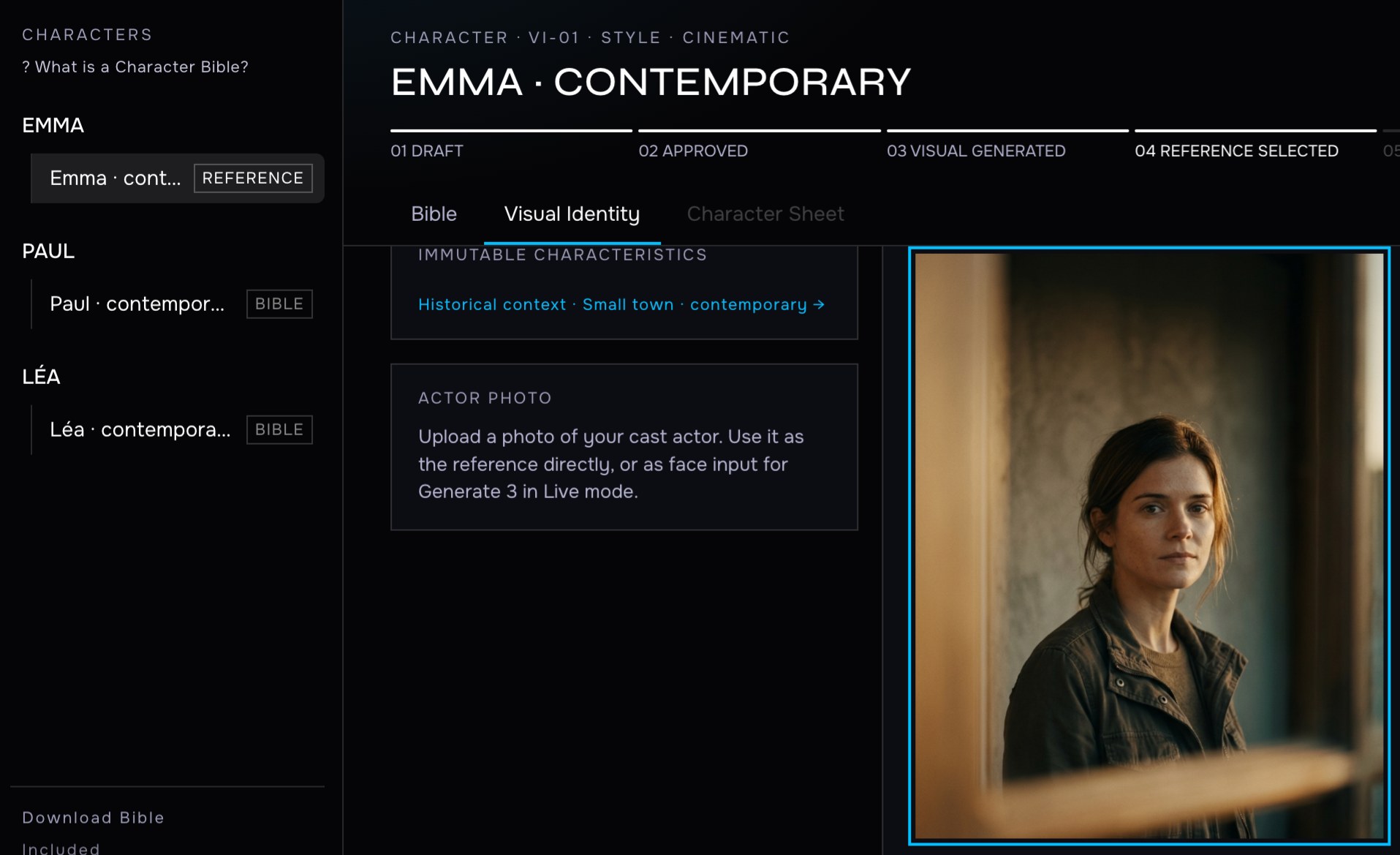
Emma’s visual identity with the approved reference. On the left, the film’s three characters.
Visual Identity: Emma’s approved reference. On the left, the film’s three characters: Emma, Paul and Léa.

03Following Emma Through the Script

A description is only the starting point. The character has to be followed through the whole screenplay. In “First Film”, Emma’s journey takes five scenes:

  • Scene 1. A railway bridge in a small town, dawn. Emma films what she imagines as the opening shot of her future film.
  • Scene 2. Paul’s hardware shop. She has been accepted to a film workshop in Paris; her father would rather she took a stable job at a bank.
  • Scene 3. A small studio in Paris. Emma has to decide whether to make her first feature film and is held back by the fear that failure would prove her father right.
  • Scene 4. A screening room. During the screening of her short film, the audience walks out.
  • Scene 5. The same bridge. This time Léa is with her, and Paul appears in the distance.

Seen this way, each scene becomes a step in her journey. The film begins and ends on the same bridge, and the difference between the first and the last scene is what the director has to show.

04From Character to Storyboard

Once we understand the character, we can decide how to show her. For the first scene, the platform suggested shots: a close-up of Emma, a wide shot of the bridge with a train, Emma with her camera, the empty tracks. The frames are made one after another with the same character, location and style, and each new frame can take continuity from the previous one. The director changes the shot size, the angle and the side, and regenerates only the frames that need it.

Storyboard of scene 1, the railway bridge at dawn: frames 1.1–1.4.
Scene 1, the railway bridge at dawn: frames 1.1–1.4. Frames 1.2 and 1.3 take continuity from the previous frame.

Emotions, actions and turning points become frames: how close the camera is when Emma argues with her father, what the light is like on the day of the screening, what we see first when she comes back to the bridge.

A character is never just a name on a page. Every scene has a reason, and every story has a journey.

What is the most important thing you look for when developing a character? Write to us at bonjour@ailumiere.com.

Margaret Tkachuk Junior Marketing Specialist, AI Lumière

Have a film in mind?

Book a call
AI Lumière
←Journal
Essay20.11.2026Margaret Tkachuk

Who Is Your Character Beyond the Script?

Every screenplay tells a story, and behind every story are characters with dreams, fears, secrets and emotions. A filmmaker reads a script to understand why things happen and what they mean for the whole story, not just what happens in each scene. This is the narrative approach we are building into AI Lumière. To show it, we wrote a short script, “First Film”, and took its heroine Emma through the platform.

01Look Beyond the Individual Scene

The director uploads the complete screenplay. The platform divides it into scenes and writes the logline, the core conflict and the synopsis. It also detects the genre: for “First Film” it proposed psychological drama. The director confirms the genre or changes it, because it will shape the visual style of every character, location and frame.

The Script stage: five scenes, logline, core conflict, synopsis and the detected genre.
The Script stage: five scenes, logline, core conflict and synopsis. The genre is detected by the platform and confirmed by the director.

From there, we explore the script as a whole and ask the questions a director asks:

  • What is the story about?
  • Who are the main and secondary characters?
  • What are their personalities, motivations, dreams, fears and conflicts?
  • How are the characters connected?
  • When and where do they appear?
  • How do they change throughout the story?
  • How can that development be translated into storyboard frames?

02The Character Bible

A character bible describes the important details of each character in a film or series. It gives the director, the screenwriter and the storyboard artist a shared and clearer picture of the people in the story.

In the platform, the bible has two parts. Identity: name, age, period, the scenes where the character appears. Character: who this person is, their role in the story, motivation and relationships. Everything is taken from the script, and what the script does not say is marked as such. Emma’s age, for example, is “Not specified in script”.

Emma’s character bible: Identity and Character.
Emma’s bible as drafted from the script. The director approves it or adds what is missing.

The script gives the facts. The director adds what they know about the character beyond the page. For Emma it could look like this:

  • Personality: creative, curious, independent, sometimes insecure
  • Background: grew up in a small town and always dreamed of working in cinema
  • Main dream: to make her first film
  • Biggest fear: failing and proving her father right
  • Main conflict: choosing between a safe career and her dream
  • Relationships: a difficult relationship with her father Paul, a strong friendship with Léa
  • Development: she slowly becomes more confident and learns to trust her own ideas

Next comes the visual identity. The immutable characteristics are fixed, the ones that must not change from frame to frame, and the director approves one visual reference. Emma’s face will be built from it in every scene. Paul and Léa go through the same steps.

Emma’s visual identity with the approved reference. On the left, the film’s three characters.
Visual Identity: Emma’s approved reference. On the left, the film’s three characters: Emma, Paul and Léa.

03Following Emma Through the Script

A description is only the starting point. The character has to be followed through the whole screenplay. In “First Film”, Emma’s journey takes five scenes:

  • Scene 1. A railway bridge in a small town, dawn. Emma films what she imagines as the opening shot of her future film.
  • Scene 2. Paul’s hardware shop. She has been accepted to a film workshop in Paris; her father would rather she took a stable job at a bank.
  • Scene 3. A small studio in Paris. Emma has to decide whether to make her first feature film and is held back by the fear that failure would prove her father right.
  • Scene 4. A screening room. During the screening of her short film, the audience walks out.
  • Scene 5. The same bridge. This time Léa is with her, and Paul appears in the distance.

Seen this way, each scene becomes a step in her journey. The film begins and ends on the same bridge, and the difference between the first and the last scene is what the director has to show.

04From Character to Storyboard

Once we understand the character, we can decide how to show her. For the first scene, the platform suggested shots: a close-up of Emma, a wide shot of the bridge with a train, Emma with her camera, the empty tracks. The frames are made one after another with the same character, location and style, and each new frame can take continuity from the previous one. The director changes the shot size, the angle and the side, and regenerates only the frames that need it.

Storyboard of scene 1, the railway bridge at dawn: frames 1.1–1.4.
Scene 1, the railway bridge at dawn: frames 1.1–1.4. Frames 1.2 and 1.3 take continuity from the previous frame.

Emotions, actions and turning points become frames: how close the camera is when Emma argues with her father, what the light is like on the day of the screening, what we see first when she comes back to the bridge.

A character is never just a name on a page. Every scene has a reason, and every story has a journey.

What is the most important thing you look for when developing a character? Write to us at bonjour@ailumiere.com.

Margaret Tkachuk Junior Marketing Specialist, AI Lumière

Have a film in mind?

Book a call