
Почему мы создаём платформу для режиссёров — AI Lumière Journal
AI Lumière
←Journal
Essay20.11.2026Olga Tarasova

Why We Are Building a Platform for Directors

In one of my documentary films, we planned a drone shot flying past a tree. Before the shoot, I wanted to understand how the composition would change and how the space behind the trunk would open up. The shot needed to be discussed with the cinematographer and the producer. In the end, we drew it ourselves.

I often needed reference images like this, even in documentary cinema. A lot comes together unexpectedly on set, but a director thinks in advance about the film’s style, camera movement and light. A few frames help explain the intention to the team and check whether we all imagine the future scene the same way.

I have been working in film for more than twenty years. Many times I wished I could turn my ideas into images faster, images that could be shown, discussed and changed. The idea of the AI Lumière platform grew out of that need.

01From a First Animation to a Platform

In 2021, I made my first video with artificial intelligence: a simple animation of a work by Van Gogh. Even then, the thought of my own platform appeared. I was drawn to the possibility of working with images in a new way and trying solutions that used to require entirely different resources.

By 2023, the progress of generative video had strengthened that decision. I wanted to build these possibilities into a director’s real work, from reading the script to preparing a project for the shoot or a meeting with a producer.

AI Lumière is growing as a studio with its own platform. While working on films, teasers and visual materials for clients, we identify the problems that we then solve in the product. Our own technology, in turn, helps us improve studio production.

02The Script as the Foundation of a Visual Story

From the very beginning, we built the platform around working with the entire script. It becomes a shared body of knowledge about the future film.

The heroine’s description may be on page one, a detail of her costume on page five, and a detail of her home much later. The historical context shapes clothing, objects and architecture. In visualisation, all of this information has to work together.

We are building a connected path from script breakdown and approval of the character bible to location design, storyboard, teaser and pitch deck. Decisions that have been made become the basis for the next stages, and the director can return to them and make changes.

We built and tested the first version. It showed how much attention the character bible needs: appearance, costumes and changes of look over the course of the story. It also became clear that series and feature films need different ways of working with the material. We are taking these lessons into the second version.
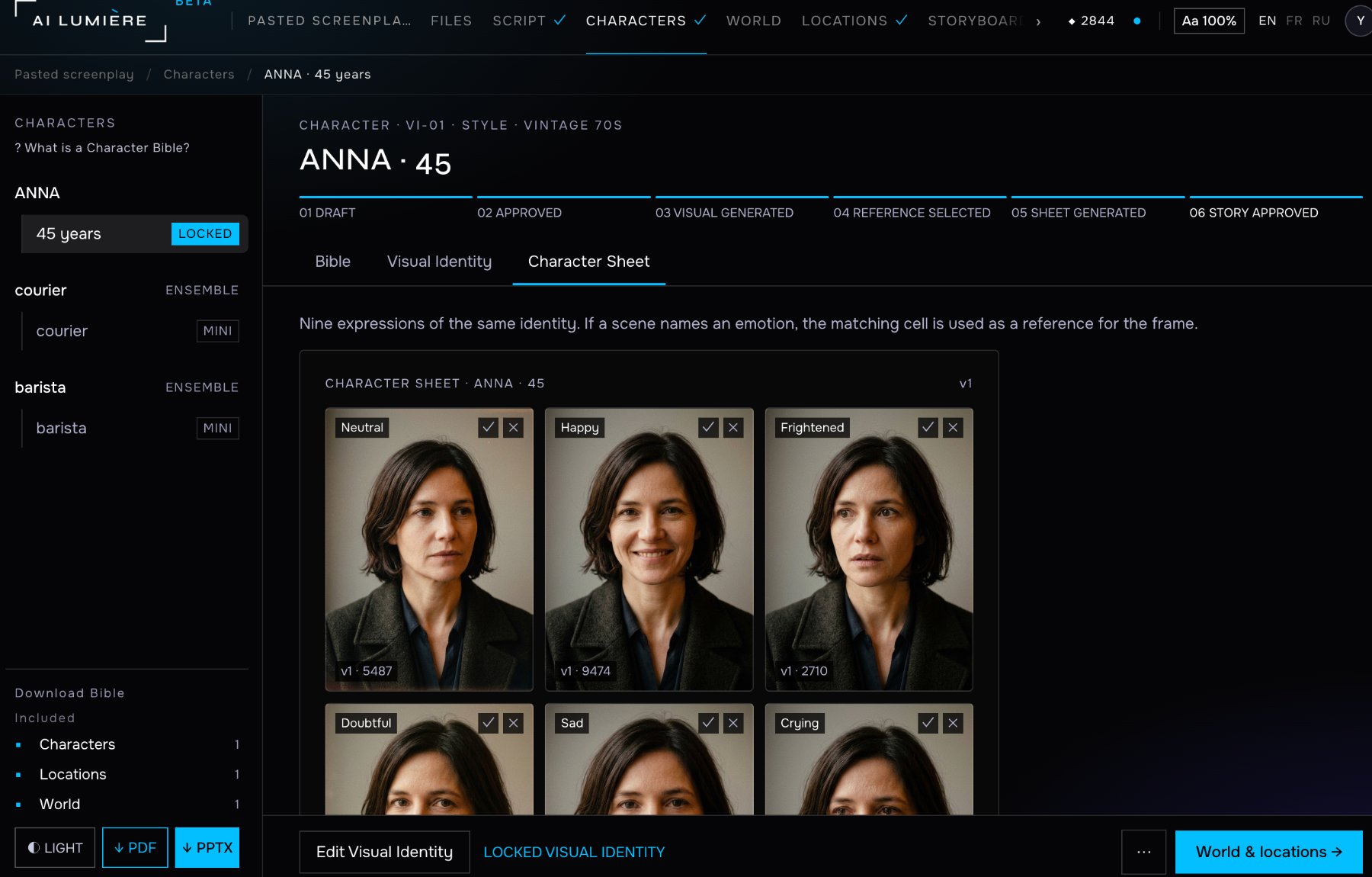
Character sheet: nine expressions of the same character, used as references for the frames.

03What Happens to the Red Coat

Imagine the heroine walks into a café in a red wool coat. Underneath, a cream blouse. She takes off the coat, hangs it on the back of a chair and sits down to wait.

In the next shot, we see the heroine in close-up. She is now in the blouse, with the edge of the red wool still behind her shoulder. Then the camera moves, and the coat appears in the foreground, still on the same chair.

Several changes are linked here. The heroine’s visible costume changes, and the coat becomes an object in the space. Its position has to be taken into account when the angle changes.
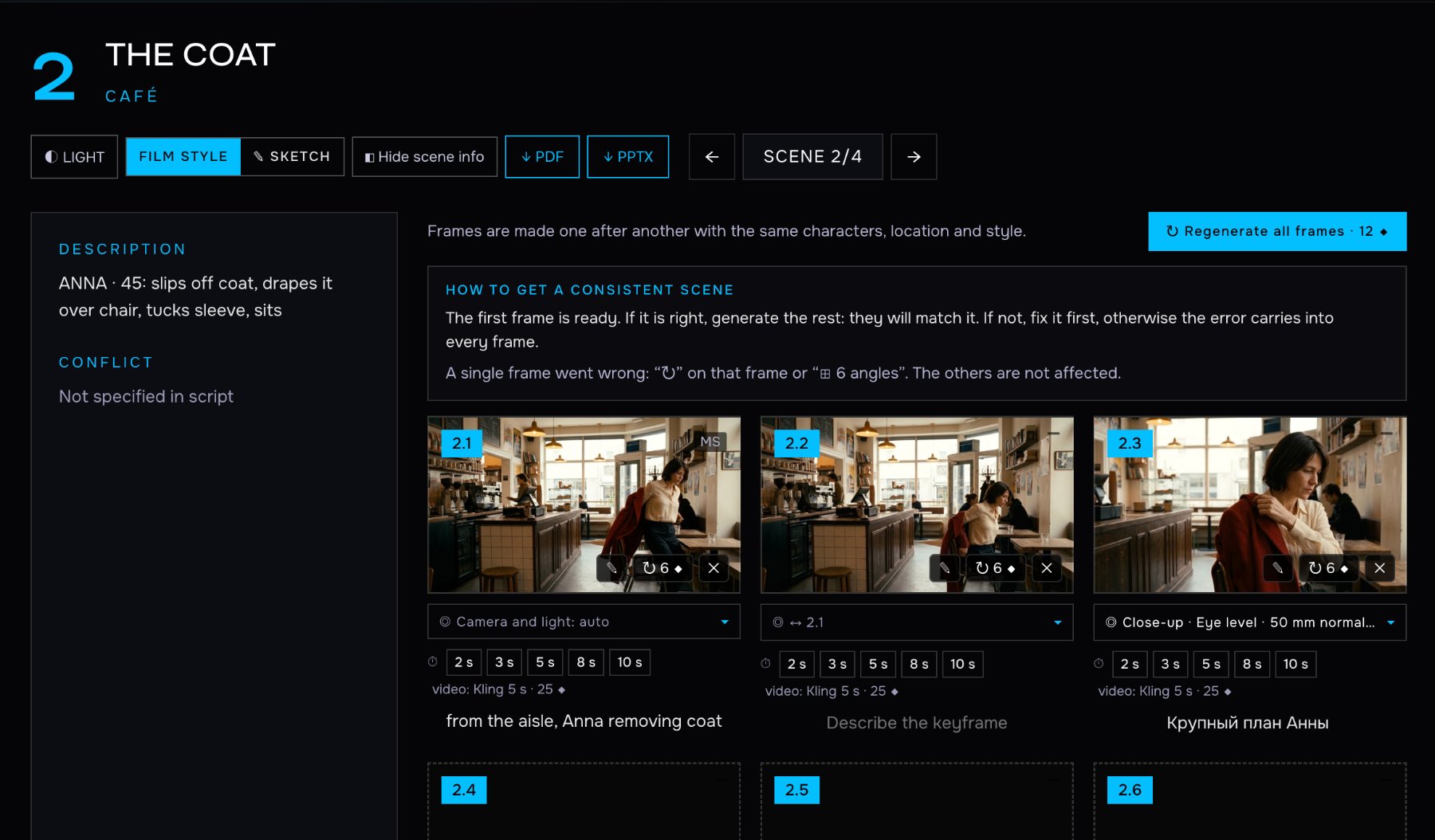
Scene 2, “The Coat”: the heroine takes off the red coat and hangs it on the chair.

We are developing logic that will record clothing in layers and track such changes. With the same aim, we are working on spatial consistency. If the action returns to the same café, the position of the door, the window, the counter and the tables must stay the same when the camera position changes.
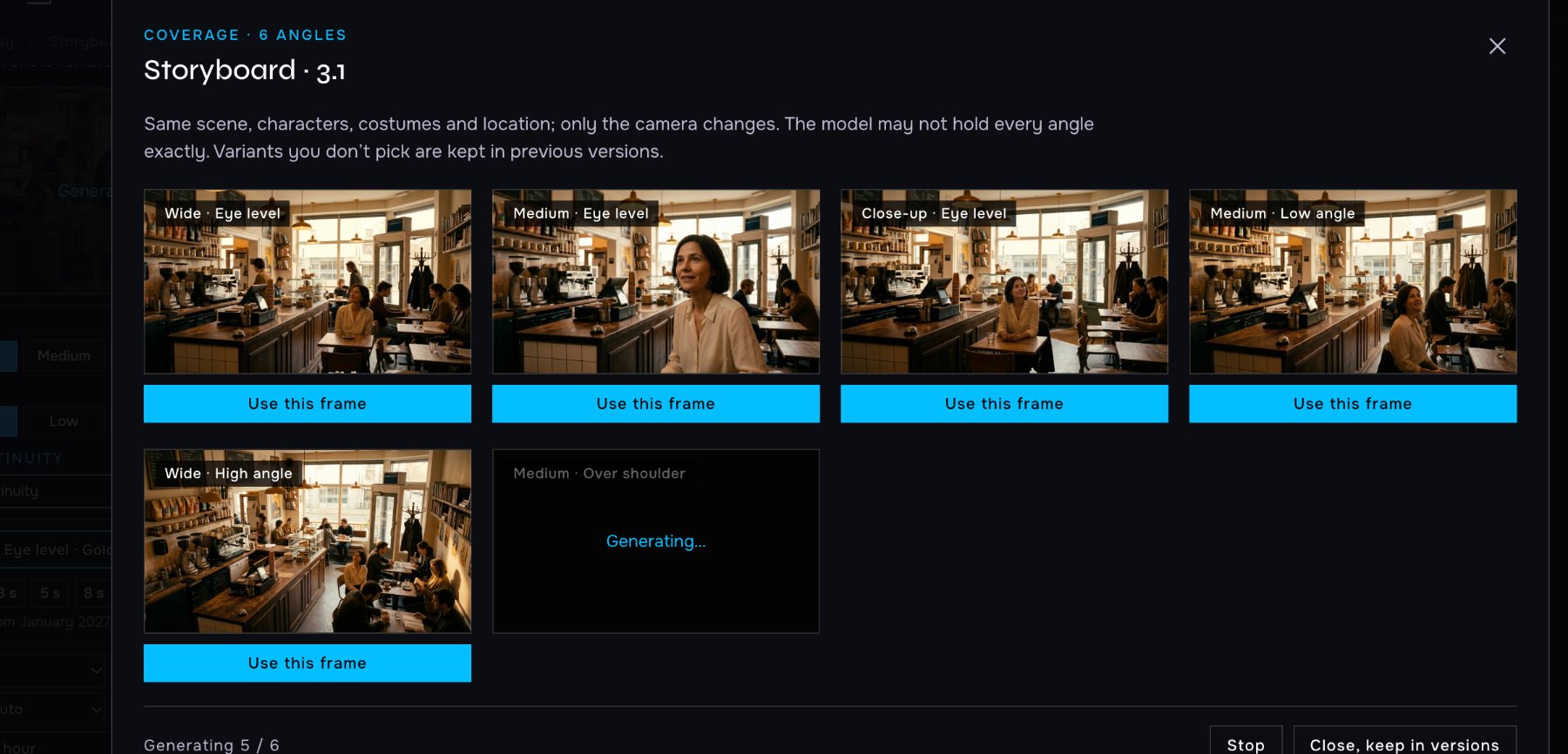
Six angles of one shot: the same café, characters and costumes, only the camera changes.

This is our narrative approach. Each shot belongs to a specific moment in the story and takes into account what happened before.

04How Far to Automate

For us, this is one of the main questions of development. The input is a script; the output is a storyboard, a pitch deck or a teaser. Between them lies a chain of decisions that require different degrees of authorial involvement.

Parsing the text, gathering details about the characters and carrying approved information from scene to scene can be entrusted to the system. Choosing a visual language, building a scene and working with the audience’s expectation require professional judgement.

Say the heroine is waiting for someone in a café. We can immediately show the empty chair across from her. Or we can start with a close-up as she looks up at the sound of the door, and only then show that she is still alone. These options reveal her waiting in different ways.
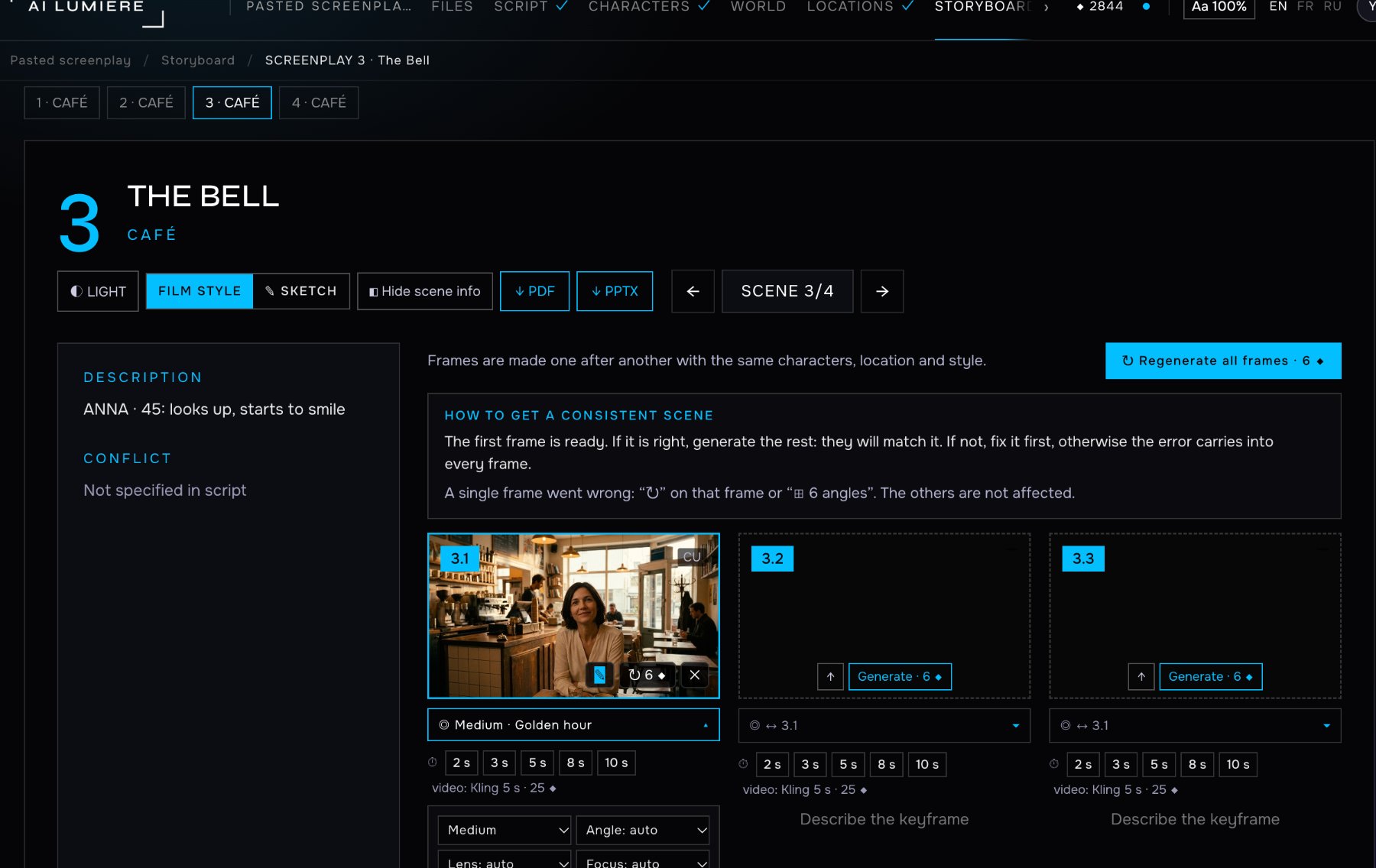
Scene 3, “The Bell”: the heroine looks up and starts to smile. The next frames are generated from the first.

We want to help the director explore such decisions at the storyboard stage. To do this, they need to see the result of each stage, understand which decisions have already been made, and be able to change them. Our first users will help us determine where automation is useful and where additional means of control are needed.

05From Storyboard to Rehearsal

Ways of working with generative video are changing quickly. Interactive control of characters and camera opens up the prospect of visual development that resembles a rehearsal. The director will be able to try a scene, watch it unfold and immediately suggest a different solution.

We want the platform to be able to evolve along with these possibilities. Its foundation remains the script and the world of the film connected to it: characters, spaces, events and decisions approved by the author. This context is needed both for the storyboard and for interactive work with the scene.

That is why the question of how far to automate remains open. Where can the system be trusted with sequential work, and where does it matter that the director controls the action personally? We explore this boundary in studio projects and in developing the platform.

We believe in the future of systems capable of carrying out complex sequential work under human artistic control. The more reliable the preparation, the more attention the author can give to the composition, rhythm and meaning of a scene.

06What We Will Show in the Closed Beta

At the end of 2026, we plan to open a closed beta of the second version of the platform to the first directors and studios. First-wave participants will receive 15 free image generations to get to know the platform on their own material. Further work will be available on a paid basis.

The platform will make it possible to go from the script and character bible to a storyboard, teaser or pitch deck. For teams preparing for meetings during the Berlinale, it is an opportunity to explore the visual language of the film and prepare materials to present it.

For us, the beta will be the next stage of working together with filmmakers on a tool we want to use ourselves.

When I think about this platform, I still remember the flight past the tree. I wanted to sit next to the cinematographer, show a few frames and ask: “What if we flew a little closer?”

It was for the chance to see a future film sooner, discuss it with the team and keep searching that I started this project.

More about the platform: www.ailumiere.fr.
Olga Tarasova
Olga Tarasova Film Director & Founder of AI Lumière

Have a film in mind?

Book a call
AI Lumière
←Журнал
Эссе20.11.2026Olga Tarasova

Почему мы создаём платформу для режиссёров

В одном из моих документальных фильмов был задуман пролёт на дроне мимо дерева. Ещё до съёмки мне хотелось понять, как будет меняться композиция и открываться пространство за стволом. Этот кадр нужно было обсудить с оператором и продюсером. В итоге мы рисовали его сами.

Мне часто были нужны такие опорные изображения, даже в документальном кино. На съёмке многое складывается неожиданно, но режиссёр заранее думает о стилистике фильма, движении камеры, свете. Несколько кадров помогают объяснить замысел команде и понять, одинаково ли мы представляем будущую сцену.

Я работаю в кино больше двадцати лет. Мне много раз хотелось быстрее переводить свои идеи в изображения, которые можно показать, обсудить и изменить. Из этой потребности выросла идея платформы AI Lumière.

01От первой анимации к платформе

В 2021 году я сделала свой первый ролик с помощью искусственного интеллекта — простую анимацию работы Ван Гога. Уже тогда появилась мысль о собственной платформе. Меня увлекала возможность работать с изображением по-новому и пробовать решения, для которых раньше требовались совсем другие ресурсы.

К 2023 году развитие генеративного видео укрепило меня в этом решении. Мне хотелось встроить эти возможности в настоящую работу режиссёра — от чтения сценария до подготовки проекта к съёмке или встрече с продюсером.

AI Lumière развивается как студия с собственной платформой. Работая над фильмами, тизерами и визуальными материалами для клиентов, мы определяем задачи, которые затем решаем в продукте. Собственная технология, в свою очередь, помогает совершенствовать студийное производство.

02Сценарий как основа визуальной истории

С самого начала мы заложили в платформу работу со сценарием целиком. Он становится общей базой сведений о будущем фильме.

Описание героини может находиться на первой странице, подробность её костюма — на пятой, а деталь обстановки в её доме — значительно позже. Исторический контекст влияет на одежду, предметы и архитектуру. При визуализации все эти сведения должны работать вместе.

Мы выстраиваем связанный путь от разбора сценария и утверждения библии персонажей до разработки локаций, раскадровки, тизера и питч-дека. Принятые решения становятся основой для следующих этапов, а режиссёр может возвращаться к ним и вносить изменения.

Мы сделали и протестировали первую версию. Она показала, сколько внимания нужно уделять библии персонажей — внешности, костюмам и изменениям облика по ходу истории. Также стало понятно, что сериалам и полнометражным фильмам нужны разные пути работы с материалом. Эти выводы мы учитываем во второй версии.

Character sheet: nine expressions of the same character, used as references for the frames.
Лист персонажа: девять выражений одного героя служат опорой для кадров.

03Что происходит с красным пальто

Представим, что героиня входит в кафе в красном шерстяном пальто. Под ним — кремовая блузка. Она снимает пальто, вешает его на спинку стула и садится ждать.

В следующем кадре мы видим героиню крупно. Она уже в блузке, за плечом остаётся край красной шерсти. Затем камера перемещается, и пальто оказывается на переднем плане, всё ещё на том же стуле.

Здесь связаны несколько изменений. Меняется видимый костюм героини, а пальто становится предметом в пространстве. Его положение нужно учитывать при смене ракурса.

Scene 2, “The Coat”: the heroine takes off the red coat and hangs it on the chair.
Сцена 2, «Пальто»: героиня снимает красное пальто и вешает его на стул.

Мы разрабатываем логику, которая позволит фиксировать одежду послойно и отслеживать такие изменения. С той же целью работаем над пространственной связностью. Если действие возвращается в одно кафе, расположение двери, окна, стойки и столиков должно сохраняться при смене точки съёмки.

Six angles of one shot: the same café, characters and costumes, only the camera changes.
Шесть ракурсов одного кадра: то же кафе, те же герои и костюмы, меняется только камера.

В этом заключается наш нарративный подход. Каждый кадр относится к определённому моменту истории и учитывает то, что произошло раньше.

04До какой степени автоматизировать

Для нас это один из главных вопросов разработки. На входе — сценарий, на выходе — сториборд, питч-дек или тизер. Между ними находится цепочка решений, которые требуют разной степени участия автора.

Разбор текста, сбор подробностей о героях и перенос утверждённых сведений между сценами можно поручать системе. Выбор визуального языка, построение сцены и работа со зрительским ожиданием требуют профессионального суждения.

Допустим, героиня ждёт кого-то в кафе. Можно сразу показать пустой стул напротив неё. А можно начать с крупного плана, когда она поднимает глаза на звук двери, и только затем показать, что она всё ещё одна. Эти варианты по-разному раскрывают её ожидание.

Scene 3, “The Bell”: the heroine looks up and starts to smile. The next frames are generated from the first.
Сцена 3, «Колокольчик»: героиня поднимает глаза и начинает улыбаться. Следующие кадры строятся от первого.

Мы хотим помочь режиссёру исследовать такие решения ещё на раскадровке. Для этого он должен видеть результат каждого этапа, понимать, какие решения уже приняты, и иметь возможность их изменить. Первые пользователи помогут нам определить, где полезна автоматизация, а где нужны дополнительные способы управления.

05От раскадровки к репетиции

Способы работы с генеративным видео быстро меняются. Интерактивное управление персонажами и камерой открывает перспективу визуальной разработки, похожей на репетицию. Режиссёр сможет пробовать сцену, наблюдать за её развитием и сразу предлагать другое решение.

Мы хотим, чтобы платформа могла развиваться вместе с этими возможностями. Её основой остаётся сценарий и связанный с ним мир фильма — персонажи, пространства, события и утверждённые автором решения. Такой контекст нужен и для раскадровки, и для интерактивной работы со сценой.

Поэтому вопрос о степени автоматизации остаётся открытым. Где системе можно поручить последовательную работу, а где режиссёру важно самому управлять действием? Мы исследуем эту границу в студийных проектах и при разработке платформы.

Мы верим в будущее систем, способных выполнять сложную последовательную работу под художественным контролем человека. Чем надёжнее устроена подготовка, тем больше внимания автор может уделить композиции, ритму и смыслу сцены.

06Что мы покажем в закрытой бете

В конце 2026 года мы планируем открыть закрытую бету второй версии платформы для первых режиссёров и студий. Участники первой волны получат 15 бесплатных генераций изображений, чтобы познакомиться с платформой на своём материале. Дальнейшая работа будет доступна на платной основе.

Платформа позволит пройти путь от сценария и библии персонажей до раскадровки, тизера или питч-дека. Для команд, готовящихся к встречам во время Берлинале, это возможность исследовать визуальный язык фильма и подготовить материалы для его презентации.

Для нас бета станет следующим этапом работы вместе с кинематографистами над инструментом, которым мы сами хотим пользоваться.

Когда я думаю об этой платформе, я всё ещё вспоминаю пролёт мимо дерева. Мне хотелось сесть рядом с оператором, показать несколько кадров и спросить: «А что, если пролететь чуть ближе?»

Ради возможности быстрее увидеть будущий фильм, обсудить его с командой и продолжить искать я и начала этот проект.

Подробнее о платформе — www.ailumiere.fr.

Olga Tarasova
Olga Tarasova Режиссёр и основательница AI Lumière

Есть идея фильма?

Записаться на звонок